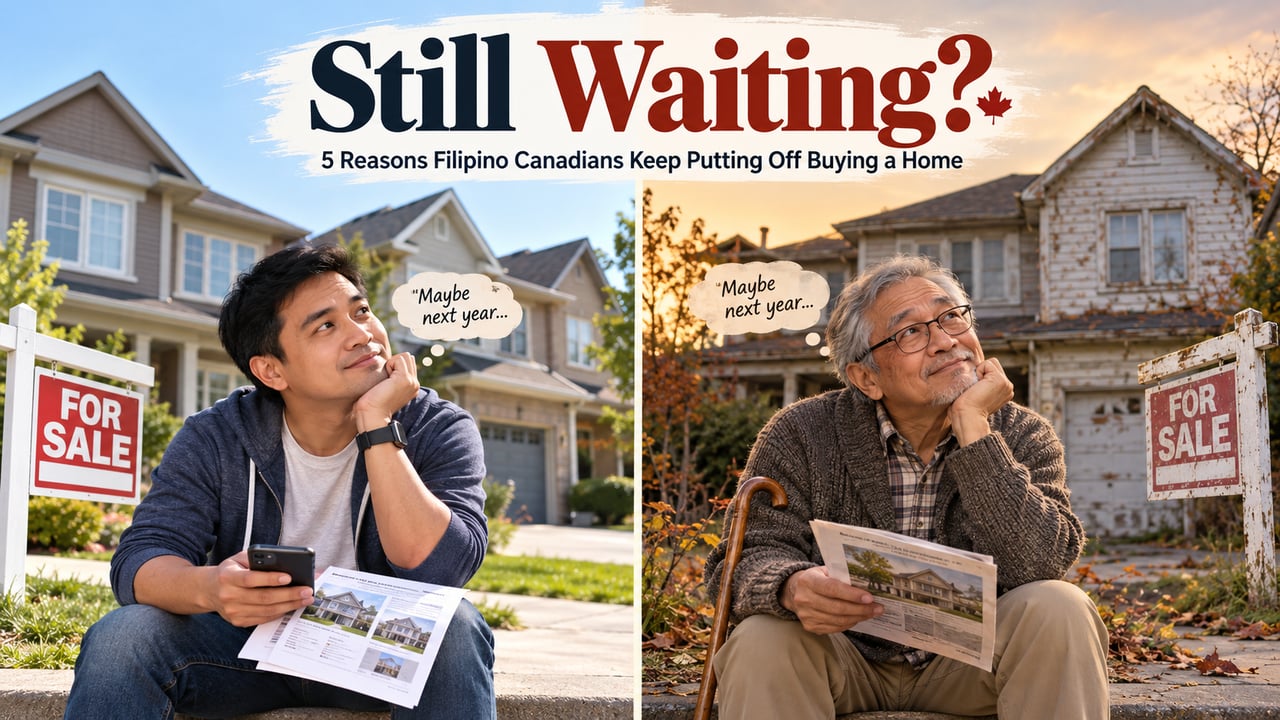
There is a very particular kind of Filipino-Canadian financial caution that comes from somewhere deep in the family history. Work hard. Save properly. Do not waste money. Make sure the bills are paid. Help the family when you can. And whatever you do, do not make a financial decision you might regret later.
That mindset has helped many families build stable lives in Canada. It came from sacrifice, uncertainty, and in many cases, starting over. But there is a downside: some of us have become so committed to being “ready” that we keep moving the definition of ready every few years.
At some point, you’re not preparing to buy anymore. You’re just getting very good at finding new reasons to wait.
If you have been renting for years and telling yourself, “Hindi pa ako ready,” here are five reasons that may be keeping you stuck — and why they may be worth revisiting.
1. “Kailangan ko muna ng malaking down payment.”
Saving for a down payment is obviously important. The problem is that some people keep adding requirements to the requirement.
First, it is the down payment. Then it is closing costs. Then emergency savings. Then another emergency fund in case the first emergency fund gets emotionally overwhelmed. Then extra money for furniture. Then extra money in case the furnace wakes up one morning and chooses violence.
There is a difference between being responsible and waiting until absolutely nothing can go wrong.
A lot of Filipino families are naturally cautious because money was hard-earned. You do not just throw it around and hope for the best. That instinct is good. But if your target keeps moving every time you get close to it, you may never feel ready enough.
You save $30,000.
Your brain says, “Good. Now pretend it does not exist.”
You save $50,000.
Your brain says, “Better. But what if something happens?”
Eventually, you have to replace “I think I need more” with actual numbers. Talk to a mortgage professional. Find out what you really need. You may still need more time — but at least now you are working toward a real target instead of a number invented by your anxiety.
2. “Hindi sapat ang sweldo ko.”
This one is powerful because many people reject themselves before anyone else gets the chance.
You look at your salary. Then you look at GTA prices. Then you quietly close the browser and start watching renovation videos of houses you have no intention of buying.
But income is only part of the picture. Your debts, credit, savings, monthly obligations and the type of property you are considering all matter too.
For Filipino Canadians, this can feel especially complicated because income is often mentally divided into several categories before payday even arrives. Household expenses. Kids. Parents. Savings. Family obligations. Travel back home. Something always seems to need funding.
So even if your income is decent, you may still feel like it is “not enough.”
And there is always a magical future salary you imagine will finally make you feel secure.
You get a raise.
“Okay, maybe one more raise.”
You get promoted.
“Maybe when I become manager.”
You become manager.
“Maybe when I stop checking the price of everything at Costco.”
That last milestone may never happen.
The point is not that everybody with a job should buy a home. The point is that you should not decide you cannot qualify without actually finding out.
Sometimes “I cannot afford to buy” really means “I cannot afford the exact house I pictured.”
Those are not the same thing.
3. “If I can’t buy a detached house, I’m not ready.”
This one has a lot of emotional weight.
For many Filipino families, the image of success still looks like a detached house with a driveway, backyard, basement and enough bedrooms for people who do not even live there yet.
So when a first-time buyer starts looking at condos or townhouses, there can be a quiet feeling of disappointment.
“Ito lang?”
Meanwhile, the budget is standing in the corner saying:
“Yes. Ito talaga.”
The bigger issue is that many younger buyers compare their first home with their parents’ current home. But your parents may have spent decades building toward that house. Their first property may have been smaller, cheaper, farther away or purchased in a completely different market.
You are comparing your Chapter One to somebody else’s Chapter Twenty-Seven.
Your first home does not need four bedrooms, a finished basement, a two-car garage, a home office, guest room, prayer room, backyard, and parking for relatives who visit twice a year.
That is not a starter home.
That is the family headquarters.
A condo can be a first move. A townhouse can be a first move. A smaller property can be a first move. The goal is not to impress anybody at the family gathering.
The goal is to buy something that makes sense for your life now and helps put you in a better position later.
4. “What if I buy... and the market drops?”
This one deserves respect because it is a legitimate fear.
Nobody wants to buy a home and then watch prices decline shortly after.
So people wait.
Prices look high.
“I’ll wait.”
Prices soften.
“Maybe they’ll go lower.”
Rates change.
“I’ll wait for rates.”
Rates improve.
“Now prices might go up. Maybe I should wait again.”
At some point, this stops being timing the market and starts becoming a hobby.
There is always something happening in real estate. Prices, interest rates, inventory, the economy, government policy, buyer confidence. The conditions are almost never perfect all at once.
And everybody seems to know someone who has been confidently predicting a Toronto real estate collapse since Facebook still had a “poke” button.
“Next year talaga.”
Eventually, “next year” deserves its own mortgage pre-approval.
Waiting can absolutely be the right decision. But it should be based on your situation, not on the hope that one morning you will wake up and everything will suddenly be cheap, rates will be low, competition will disappear, and sellers will personally thank you for making an offer.
The better question is not, “Is this the perfect market?”
It is, “Does buying make sense for me in this market?”
5. “What if something goes wrong after I buy?”
This one runs deeper than money.
For families who worked hard to create stability in Canada, buying a home can feel scary because suddenly there is a very large responsibility attached to your name.
What if I lose my job? What if the furnace breaks? What if there is a major repair? What if my parents need help? What if interest rates change? What if life happens?
Filipinos can be exceptionally talented at preparing for the worst-case scenario.
We do not stop at Plan B.
We sometimes prepare for Plan C, D, E, and one unnamed emergency involving a roof, job loss, family crisis and broken appliance all occurring on the same Tuesday.
Being cautious is smart. Homeownership does come with risk and unexpected expenses. But there is no major financial decision where every possible problem has been eliminated beforehand.
You do not need a life where nothing can go wrong.
You need a plan that gives you enough room to handle normal things when they do.
That means buying within your means, keeping emergency savings, understanding your mortgage, and not stretching yourself simply because a lender says you technically can.
There is a big difference between maximum approval and comfortable living.
Your lender does not have to buy groceries with you afterward.
Maybe You Are Not Ready. That Is Okay.
The point of this article is not to tell every Filipino Canadian renter to rush out and buy a home.
Some people should keep renting. Some want flexibility. Some need more savings. Some need to reduce debt. Some simply do not want the responsibilities of owning right now.
All valid.
But there is a difference between knowing you are not ready and spending years assuming you are not.
Many of us were taught to be careful with money because our families understood how difficult it was to earn. That lesson should stay.
But being careful should not automatically mean standing still.
If you have been renting because you think you need more savings, a bigger salary, a detached house, the perfect market and complete financial certainty before you can even begin, maybe the next step is not buying a home.
Maybe the next step is simply finding out where you actually stand.
Talk to RCC Real Estate Group. We can help you look at your budget, your options and what kind of property may realistically make sense for you — now or later.
Maybe the answer is:
“Not yet.”
Great. Now you have a plan.
Or maybe the answer is:
“Wait... pwede na pala?”
Either way, that is better than spending another five years preparing to someday start preparing.